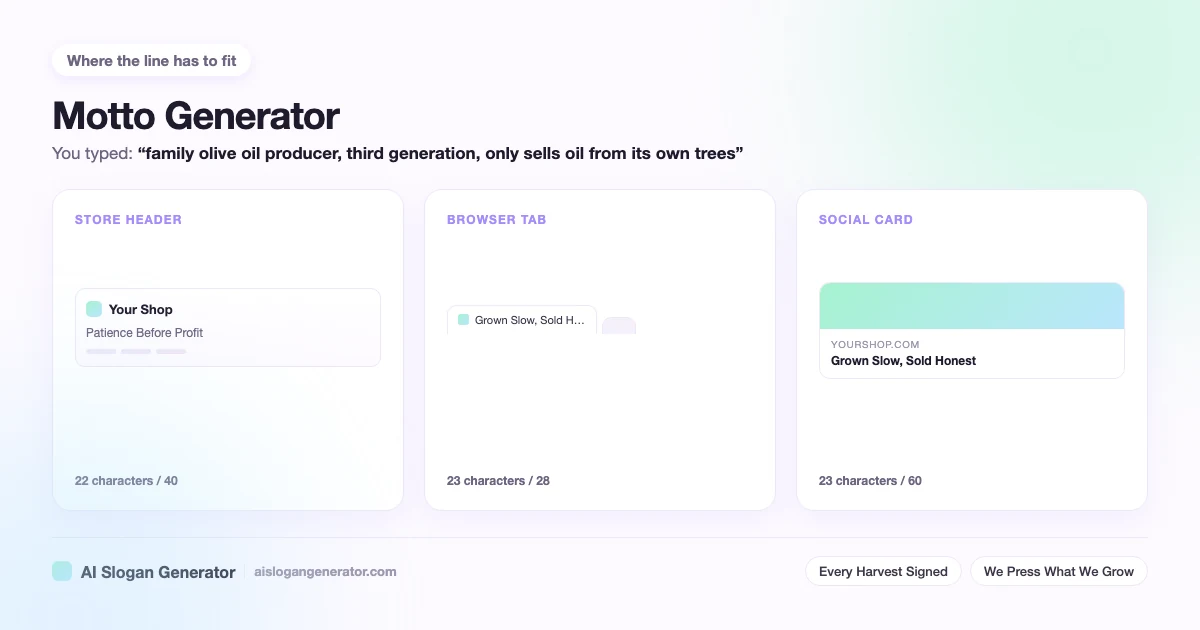
A motto generator sounds like a slogan tool with a different label, but the job is turned around. A slogan speaks to the customer and asks for something. A motto speaks to the people inside the business and tells them what it stands for. This page is about that inward line: who it is for, what voice it takes and where it belongs.
What is a motto?
A motto is a short line that states a principle an organisation lives by. It is written for the people inside it, the founders, staff and anyone who joins later, rather than for buyers. A good motto works as a rule you can check a decision against.
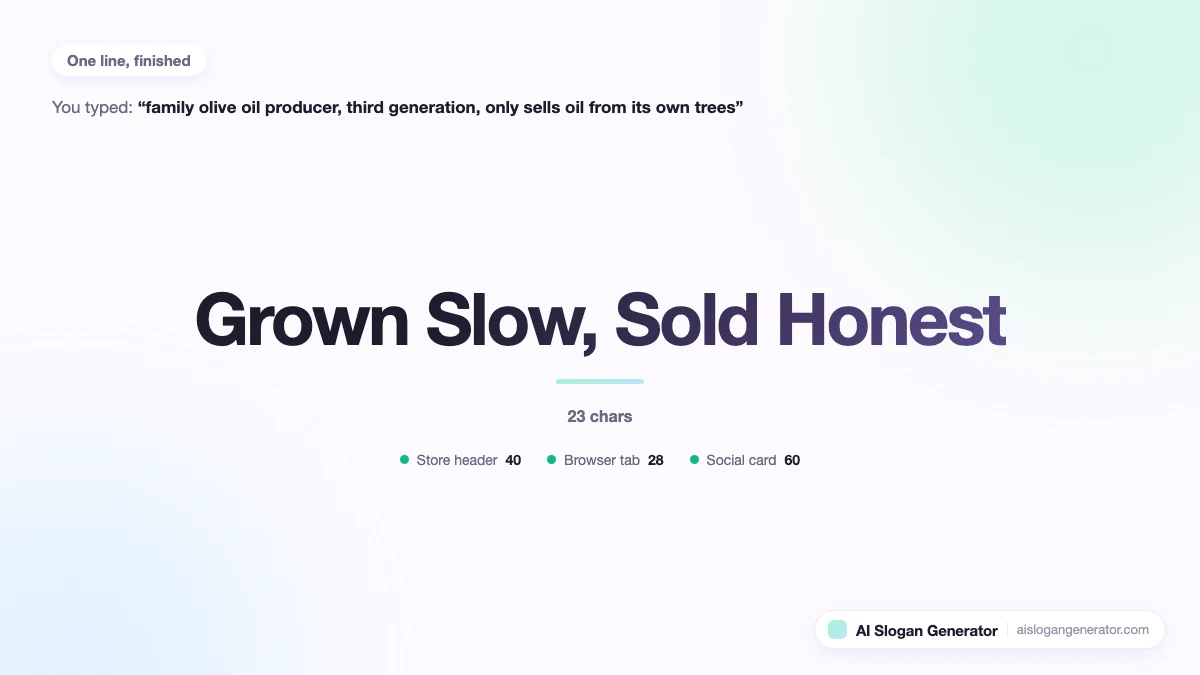
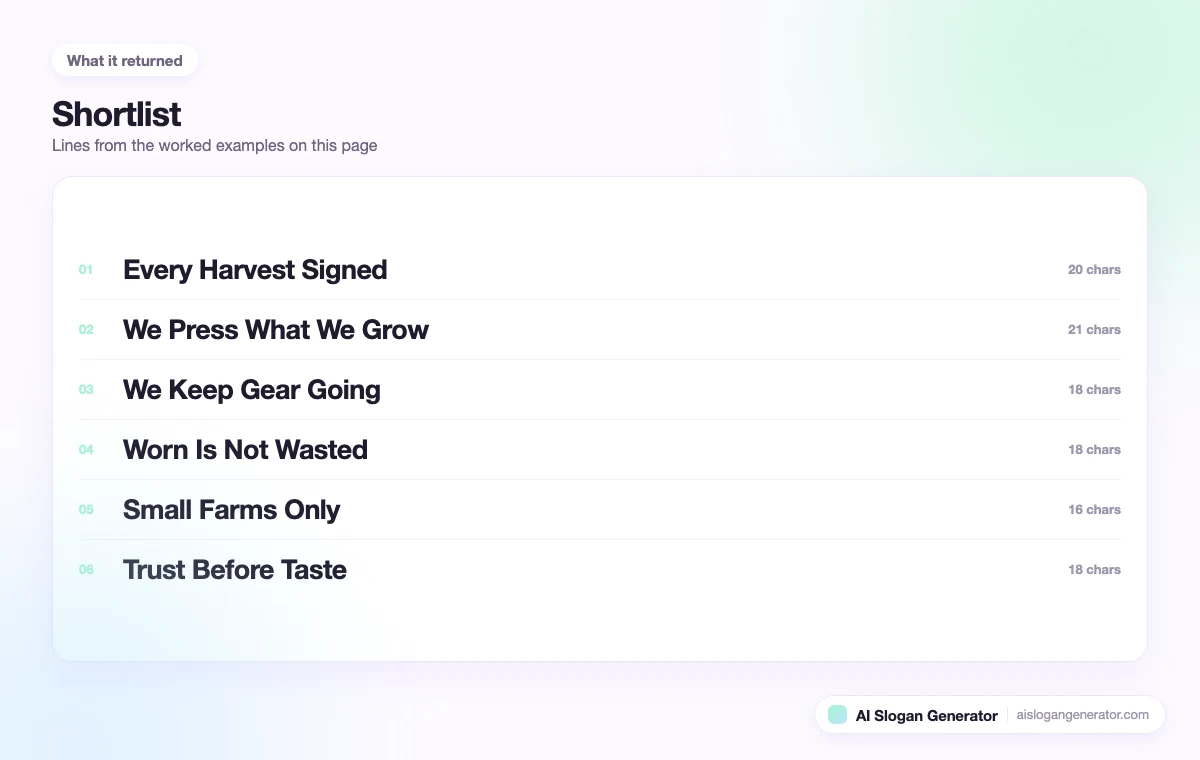
That last point is the useful test. We press what we grow tells an olive oil producer never to buy in someone else's oil, even in a bad year. Nothing leaves broken tells a secondhand gear shop that every item gets checked and fixed before it ships. Neither line is trying to win a sale. Both are trying to settle an argument before it starts.
Families, schools, clubs, regiments and cities have had mottos for centuries, long before anyone wrote a slogan. Businesses borrowed the idea later, and most of them use it loosely. On this page a motto means the rule, not the advert.
How is a motto different from a slogan?
A slogan faces outward and a motto faces inward. A slogan is written for a customer who has never heard of you and is meant to make them act. A motto is written for the people already inside and is meant to tell them how to behave when nobody is watching.
The difference shows in almost every choice you make while writing one:
- Audience. A slogan addresses a buyer. A motto addresses the team, and sometimes the founder talking to their future self.
- Verb. A slogan's verb is usually something the customer does: shop, try, taste. A motto's verb is something the business does: press, mend, answer, buy.
- Proof. A slogan can promise. A motto has to be kept, so it should only say what you are willing to be held to.
- Lifespan. A slogan can change with a campaign. A motto should outlast the current product range, because it describes how you work rather than what you sell.
Because of that, a line can be a strong slogan and a weak motto at the same time. The best olive oil you will ever taste might sell a bottle, but nobody on the team can act on it. If you want the outward line, start with the slogan generator, which covers length budgets and styles for lines meant to sell.
Should a motto be written in the first person?
Often, yes, and in the plural. "We" is the most natural voice for a motto because the line is a promise the group makes about itself. The other strong option is a plain instruction with no pronoun at all, such as Reply the same day, which reads like a house rule.
The voice I would avoid is "you". A line written in the second person is talking to a customer, and once it is talking to a customer it has turned back into a slogan. You deserve better tea is aimed at a shopper. We know every farmer is a commitment the business makes and can be checked on.
There are three voices that work, and each suits a different kind of business:
- First person plural, "we press", "we buy": best for small teams where everyone can name the people the line is about.
- Bare instruction, "reply", "mend", "ship": best when the motto doubles as a working rule on a wall or in an onboarding document.
- No verb at all, such as Small farms or nothing: best when the principle is a limit rather than an action.
"I" is rare and usually belongs to a personal motto rather than a business one. It can work for a solo maker who is the brand, but it stops fitting the moment a second person joins.
Where does a motto belong on a website?
A motto belongs on the pages where people learn how you work: the about page, the careers page, the footer of an order email or a card in the parcel. It does not belong in a product headline or an ad, where the reader is deciding whether to buy and wants a benefit instead.
The about page is the natural home. Someone reading it has already decided to look past the product and wants to know who is behind it, which is exactly the question a motto answers. Put it near the founding story, as a line the story leads up to, rather than as a decoration at the top.
The careers page is the second home, and an underused one. A motto tells an applicant what the work will be like more honestly than a list of perks does. Nothing leaves broken tells a repair technician that speed will never be traded for a missed fault.
Off the website, a motto earns its place on the inside of a packing box, on the wall where orders are packed and in the first page of any document a new hire reads. Those are the places where someone is about to make a small decision, which is when the line is meant to be remembered.
If you want something that runs beside your name on the logo and the header, that is a different line with different rules, and the tagline generator covers it, including how a line survives being shrunk in a lockup.
Why are so many mottos in Latin?
Latin was the shared written language of European schools, churches, courts and noble families for centuries, so the institutions that adopted mottos first wrote them in it. The habit stuck because Latin reads as permanent, it is compact, and it sounds formal even to people who cannot translate it.
Some of those lines are still in daily view. E pluribus unum is on the Great Seal of the United States, and Semper fidelis is the motto of the United States Marine Corps. Both are short, both describe a principle rather than a benefit, and both have lasted far longer than any advertising line written in the same period.
For a business, I would think twice before following that habit. A Latin motto signals age and tradition, which suits a family firm, a heritage craft or a product sold on its history. It reads as costume on a brand that launched last year, and it fails the main test of a motto if the team cannot say what it means.
If you want one anyway, write the line in plain English first and make sure it holds up as a rule. Then have it translated by someone who reads Latin properly, because word-for-word translation tools get Latin grammar wrong often enough that the mistake ends up engraved.
How do I get a usable motto out of the generator?
Describe how the business works, not what it sells. The generator returns better mottos when the description includes a rule you already follow, such as who you buy from, what you refuse to do, or what happens before an order ships. A product description alone tends to produce slogans.
Compare two descriptions of the same business. "Tea shop selling green and black tea" gives the tool nothing to stand on, so it falls back to selling lines. "Independent tea importer that buys from small farms only" gives it a principle, and lines such as Small farms only and We know every farmer come straight out of it.
Once you have a list, I would run each candidate through three questions:
- Could a new hire use this line to make a decision on their first day?
- Would the business still be keeping this promise if the product range changed completely?
- Is there a week, recently, when keeping it cost you something?
A line that passes all three is a motto. A line that passes none is a slogan, which is still useful, just somewhere else on the site. If the line you like best is one customers would enjoy repeating back, it may be a catchphrase instead, and the catchphrase generator is built around how a line sounds when someone else says it.