A slogan generator gives you a starting point, not a finished line. The useful part is not the first result. It is reading twenty five lines side by side and noticing which register fits what you actually sell. This page covers how long a line can be before the place you put it cuts it off, which style wins under which conditions, how to rewrite a weak line into a usable one, and what happens if you try to register it.
What is a slogan generator?
A slogan generator turns a short description of your business into lines you can choose between. It is a shortlist tool rather than an answer. You supply the subject and the buyer, it supplies range, and you supply the judgement about which line survives.
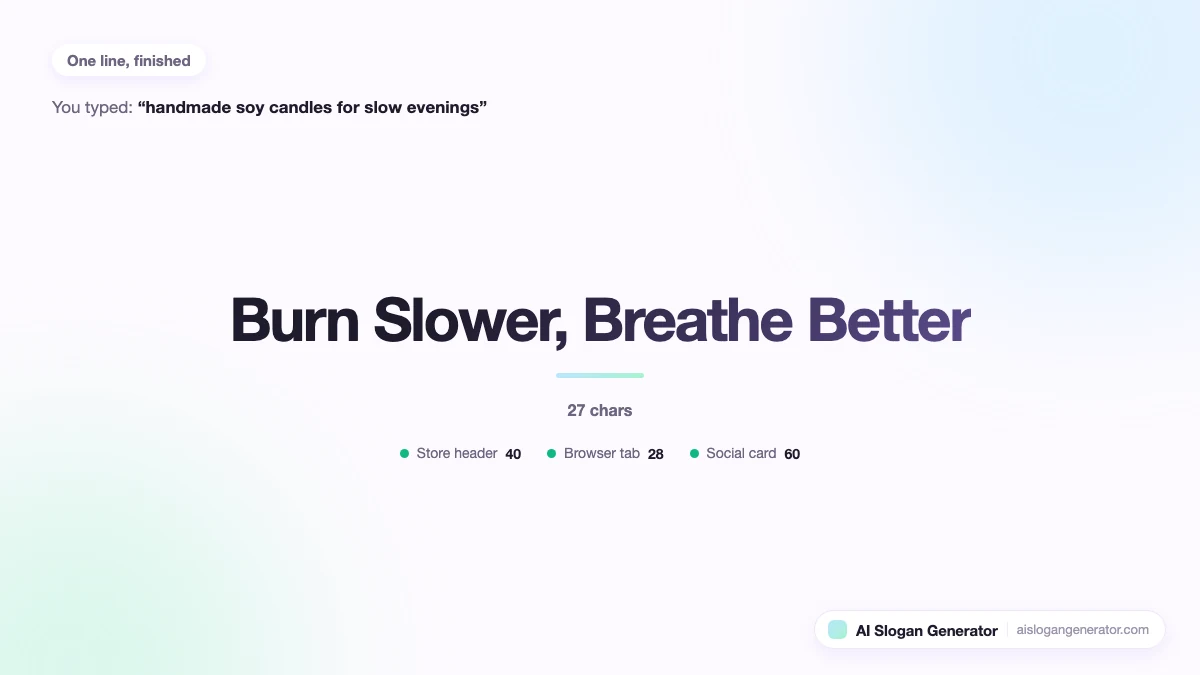
The input matters more than people expect. Two words gives you two words worth of range. Say what you sell and who buys it and the results separate immediately. Compare what comes back from candles against handmade soy candles for slow evenings. The second one has something to work with.
What a generator cannot do is know your market. It does not know that your buyers compare you on delivery speed, or that the word you like is already on a competitor's shopfront two streets away. Treat the output as raw material.
How long should a slogan be?
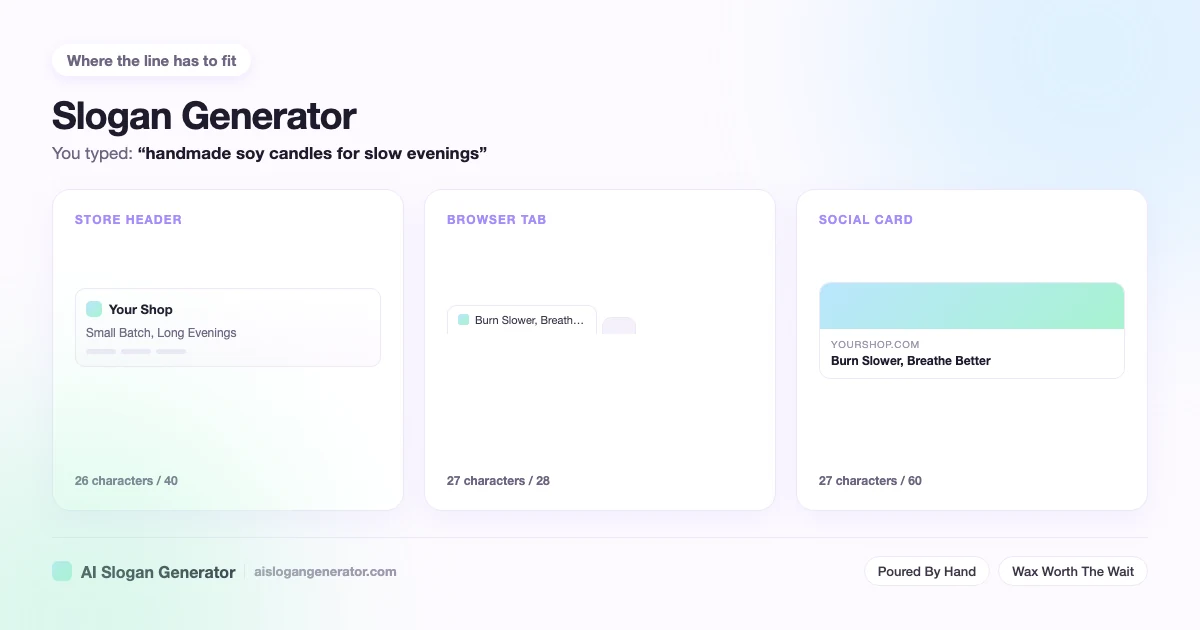
Length is decided by where the line is displayed, not by a rule about word counts. A shop header holds far more than a browser tab. Write to the tightest surface you will actually use, and the line will survive everywhere else you put it.
Most advice stops at "three to five words", which is not a guide, because it ignores the only thing that decides the answer. These are the budgets we write to:
- Store header, about 40 characters. Past that it wraps on a phone, and a wrapped tagline reads as two broken thoughts.
- Browser tab, about 28 characters. The tab is the harshest surface on the web. Anything longer is cut with an ellipsis and nobody ever sees the end of it.
- Social share card, about 60 characters. More room, but the card also carries your shop name, so the line competes with it.
- Ad headline, about 30 characters. Tight, and truncation here costs money rather than just looking untidy.
- Printed label or a stamp, under 25 characters. Small print and a curved surface punish anything long.
The practical version: if the line fits a browser tab, it fits everything. That is why we write to 28 characters first and treat the extra room elsewhere as a bonus rather than a budget to spend.
Word count follows from this. Four short words usually land under 28 characters. Four long ones do not. Count characters, not words.
What are the main slogan styles, and when does each one win?
Seven styles cover almost everything, and each one wins under a specific condition. Naming the style is the easy half. The useful half is knowing the condition it needs and the way it fails when that condition is absent.
Most pages list styles as adjectives and leave you to guess. Here is when each actually beats the others, and what goes wrong when it does not.
- Plain. Wins when nobody has heard of you and the category is not obvious from your name. Fails by being forgettable, which is a cost worth paying early.
- Bold. Wins when you compete on one measurable thing: price, speed, durability. Fails by overclaiming, and an overclaim you cannot meet is worse than silence.
- Playful. Wins when your buyer is browsing rather than hunting. Fails by ageing, because a joke dates faster than a promise.
- Elegant. Wins when you charge a premium and restraint is the signal. Fails by saying nothing at all, which is easy to mistake for sophistication.
- Creative. Wins when the product has a story that a plain line would waste. Fails by needing explanation, and a line that needs explaining has already lost.
- Modern. Wins when the buyer is choosing partly on how current you look. Fails fastest of all, because this year's vocabulary is next year's tell.
- Classic. Wins when age and continuity are the product. Fails by sounding like a claim you have not earned if the business is two months old.
One pattern worth naming: the rhythmic pair, two short halves balanced against each other. It is not a style so much as a shape, and it works across most of the styles above because a balanced line is easier to repeat than an unbalanced one.
How do you turn a weak slogan into a strong one?
Rewriting beats regenerating. A weak line usually has one fixable fault: it claims something unverifiable, it names a category instead of a difference, or it is simply too long. Fix the fault and the same idea often becomes usable.
Nobody shows this, so here are four pairs. Same business, same idea, one rewritten.
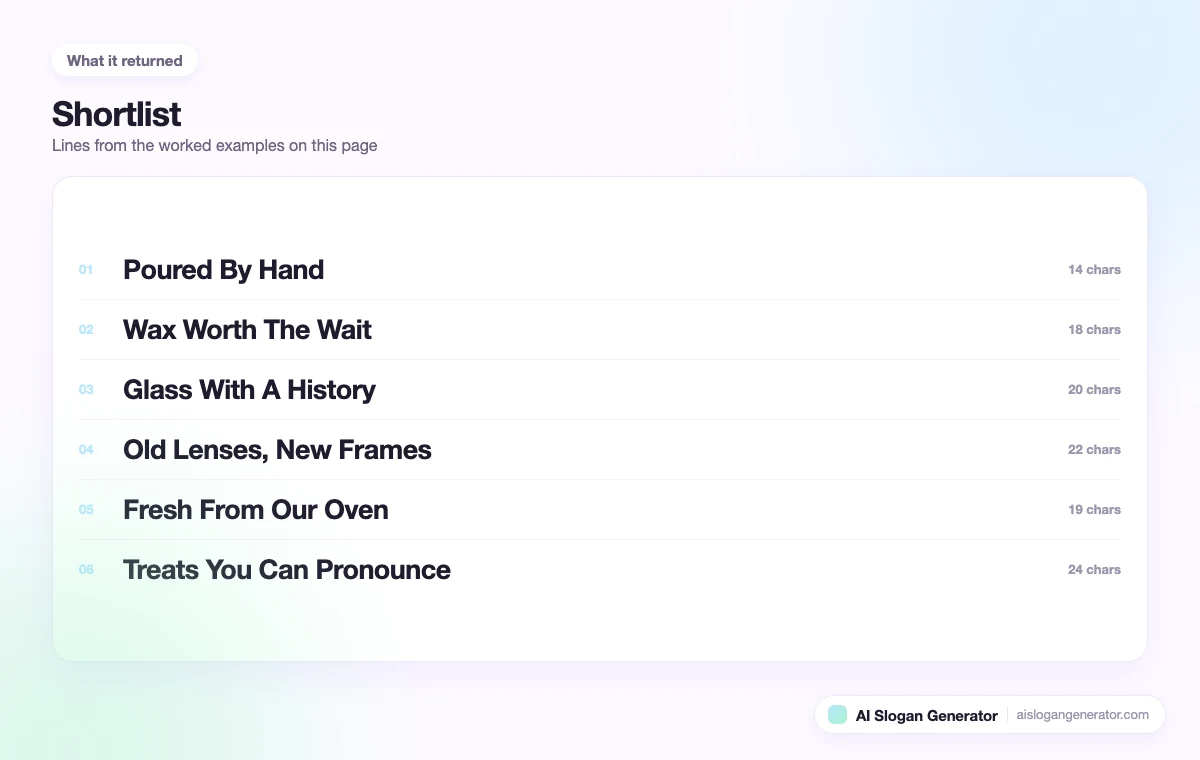
- Quality Baked Goods For Everyone becomes Baked Tuesday, Gone Friday. The first could belong to any bakery alive. The second is specific, has a rhythm, and quietly says the thing you want said, which is that it sells out.
- Your Trusted Pre-Owned Partner becomes Second Hand, First Choice. Four words instead of five, and the short one says the same thing while being repeatable.
- Premium Optical Solutions Provider becomes Glass With A History. Nobody has ever bought from a solutions provider. The rewrite names the actual object and gives it a reason to be interesting.
- All Natural Wholesome Nutrition becomes Treats You Can Pronounce. One makes four claims you cannot check. The other makes one you can check by turning the packet over.
The common thread is that every rewrite swapped an adjective for a fact. Adjectives are what a generator reaches for first and what you should strip out first.
Can you trademark a slogan?
Sometimes, and most generated lines cannot be. A mark has to be distinctive rather than merely describe what you sell, and you have to be using it in trade. Those two tests rule out the majority of short descriptive lines immediately.
The distinction that decides it is descriptive against distinctive. A line that describes the goods, praises them in ordinary language, or states an obvious benefit is usually refused, because registering it would stop every competitor from describing their own products. A line that is arbitrary, suggestive or odd has a much better chance.
Use in trade is the other half. A slogan sitting unused in a document is not a mark. It becomes one by appearing on the goods, the packaging or the shopfront, consistently, over time.
Three practical consequences:
- A line built from the plain style is the least likely to be registrable, by design. That is a reasonable trade for being understood early on.
- Search before you print. Finding the line on a competitor's packaging after a print run is an expensive way to learn this.
- Not every line needs protecting. Most small shops never register a slogan and lose nothing by it.
None of this is legal advice, and the rules differ by country. It is the shape of the question, so you know whether it is worth asking someone qualified.
What is the difference between a slogan, a tagline, a motto and a catchphrase?
They differ by who says the line and how long it lasts. A slogan sells, a tagline identifies, a motto states a principle, and a catchphrase is repeated by other people. Picking the wrong one is why a line can feel subtly off.
Four words that get used interchangeably and should not be:
- Slogan. The brand says it, it sells something, and it can change with the campaign. Shortest lifespan of the four.
- Tagline. Sits permanently beside the name, usually under a logo. It identifies rather than sells, and it should still be true in five years.
- Motto. States a principle the business holds. It faces inward, towards the people who work there, which is why it reads naturally as we.
- Catchphrase. The audience says it, not you. It is built for sound and repetition, and you cannot decide to have one.
A quick test: if the line stops being true when the campaign ends, it is a slogan. If it stops being true when the business changes what it sells, it is a tagline. If it stops being true in a bad quarter, it was never a motto.
How do you test a slogan before you commit to it?
Say it out loud twice, put it where it will actually live, and leave it a day. Most lines fail one of those three. Testing costs nothing and catches the mistakes that are expensive to undo once the line is printed.
A short routine that works:
- Read it aloud, twice. If it trips your tongue it will never be repeated by anyone else. Rhythm is not decoration, it is whether the line travels.
- Paste it where it goes. Into the header, into the tab title, onto the share card. A line that looks fine in a document and wraps on a phone is not fine.
- Say it to someone who does not know the business. Ask them what you sell. If they cannot tell you, the line is doing the wrong job.
- Leave it overnight. Clever lines decay fastest. If it still reads well the next morning it is probably not merely clever.
- Search it. Someone may already be using it, and better to know now.
Shortlist three, not one. Comparing three real candidates is far easier than judging a single line in isolation, and the comparison usually makes the answer obvious.
What makes a slogan age badly?
Lines age when they are tied to something that moves. A price, a technology, a channel or a trend all change faster than a business does, and a line pinned to any of them becomes a quiet advertisement for how long ago you wrote it.
The four most common anchors, worst first:
- A price or a number. Cheapest, fastest and under a fiver all become either untrue or embarrassing, and usually within a year.
- A technology. Naming the current platform, device or format dates a line precisely. It reads fine today and reads like a timestamp later.
- A channel. Pointing at wherever attention happens to be right now ties your identity to someone else's product decisions.
- A trend word. The vocabulary that feels current is the vocabulary everyone else is also using, which makes it both dated and crowded.
The way out is to anchor to something that does not move: what the thing is, who it is for, or what you refuse to do. Those are still true in five years.
Do you actually need a slogan?
Often not, and an empty header beats a line that says nothing. A slogan earns its place when your name does not explain the category, or when you need one repeatable sentence. Otherwise it is decoration you have to maintain.
Three cases where it genuinely helps. Your name is abstract and gives no clue what you sell, so the line does the explaining. You sell something people compare carefully and you need one sentence about why you. Or you are about to run ads, where a consistent line is doing real work across a lot of impressions.
Against that, a shop with a descriptive name selling an obvious product often needs nothing. Filler under a clear name is worse than blank space, because it spends attention and returns nothing. Ship without one rather than ship filler, and come back to it when you have something worth saying.