A catchphrase generator has a stranger job than a slogan tool. A slogan is read on a page. A catchphrase is said out loud, by somebody else, often without the brand anywhere in sight. That changes what a good line looks like, and this page is about the part most guides skip: how the line sounds.
What is a catchphrase?
A catchphrase is a short line that other people repeat because it is fun to say. It belongs to a person, a show, a stall or a brand, but it only works once the audience starts saying it back. Meaning matters less than sound.
That last part is what separates it from every other kind of line on this site. A slogan is something the brand says to sell. A tagline is something that sits beside the name for years. A catchphrase is something the customer says, at the counter, in the comments or to a friend, and the brand only gets credit if the line travels with it.
So the test for a catchphrase is not whether it explains the product. It is whether a stranger would bother repeating it. Most lines fail that test, including plenty of good slogans, and that is fine: not every business needs one.
Why does rhythm matter more than meaning in a catchphrase?
People repeat what feels good in the mouth, not what is most accurate. A line with a strong beat is easy to remember after one hearing and easy to say without thinking. A line with a precise meaning and no beat gets paraphrased, and a paraphrase carries no brand.
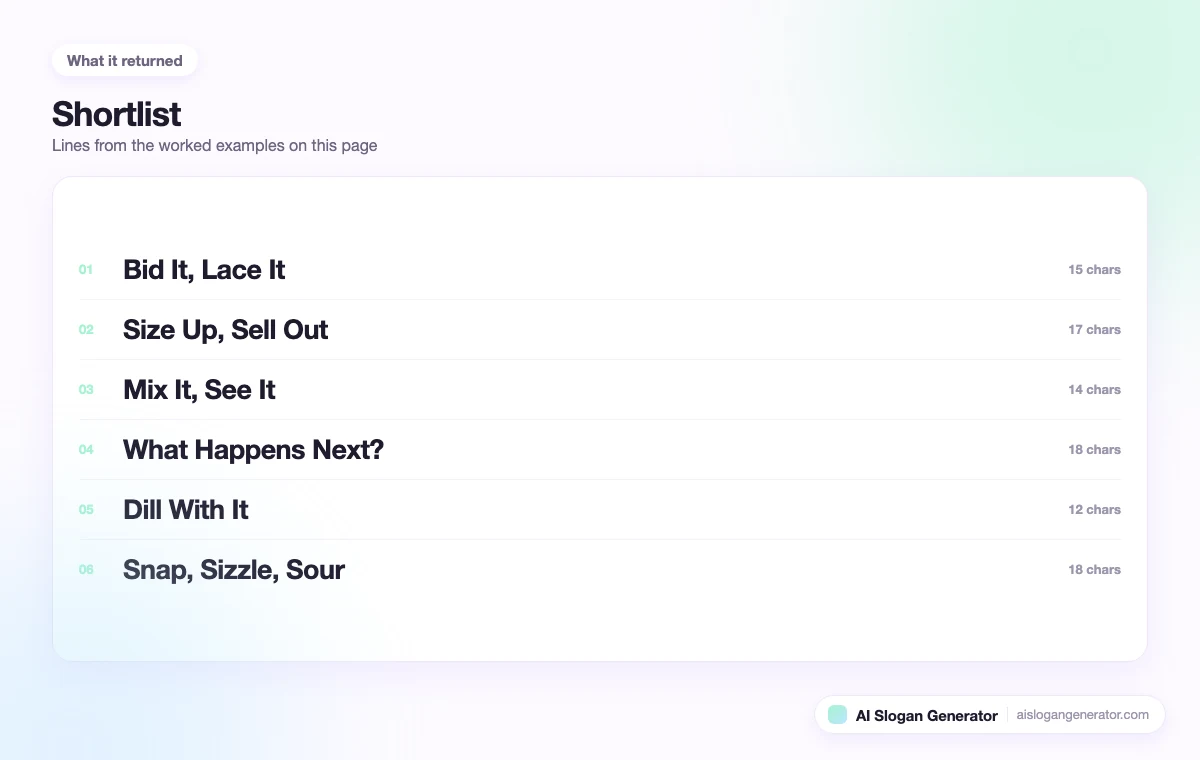
Say these two out loud: Experience the ultimate in crunchy pickled flavor and Dill with it. The first is a sentence. The second is three syllables with a pun in the middle, and it is the one a customer at a market stall would say back to the seller.
Rhythm comes from where the stress falls. In English, some syllables land hard and some fall away. Lines that alternate in a clean pattern, or that stack hard syllables one after another, feel finished. Lines where the stress wanders feel like the middle of a sentence, and nobody repeats the middle of a sentence.
A practical way to hear it is to tap the table on every stressed syllable. Fizz, pop, find out gets four even taps. Science kits that make learning fun for kids gets a lumpy pattern you cannot keep in your head. The tapping test takes ten seconds and catches most weak lines.
How many syllables should a catchphrase be?
I aim for four to six syllables, and I would rarely go past eight. Below four, a line is often just a word, which is hard to own. Above eight, people start dropping parts of it when they repeat it, and the part they drop is usually the brand.
Syllables matter more here than word count, because a catchphrase is heard rather than read. Brine time is two words and two syllables. Crunch first, ask later is four words and five syllables. Both are short enough to say in one breath, which is the real limit.
A rough guide by use, based on how each line is delivered rather than on any measured average:
- Shouted or chanted, at a live stream, a stall or an event: two to four syllables, with a hard stress on each.
- Said at the end of a video as a sign-off: four to seven syllables, so it can land after a pause.
- Repeated in comments and captions: up to eight syllables, because people type it as well as say it.
- Printed on merchandise: whatever fits in one breath, since buyers will read it aloud to each other.
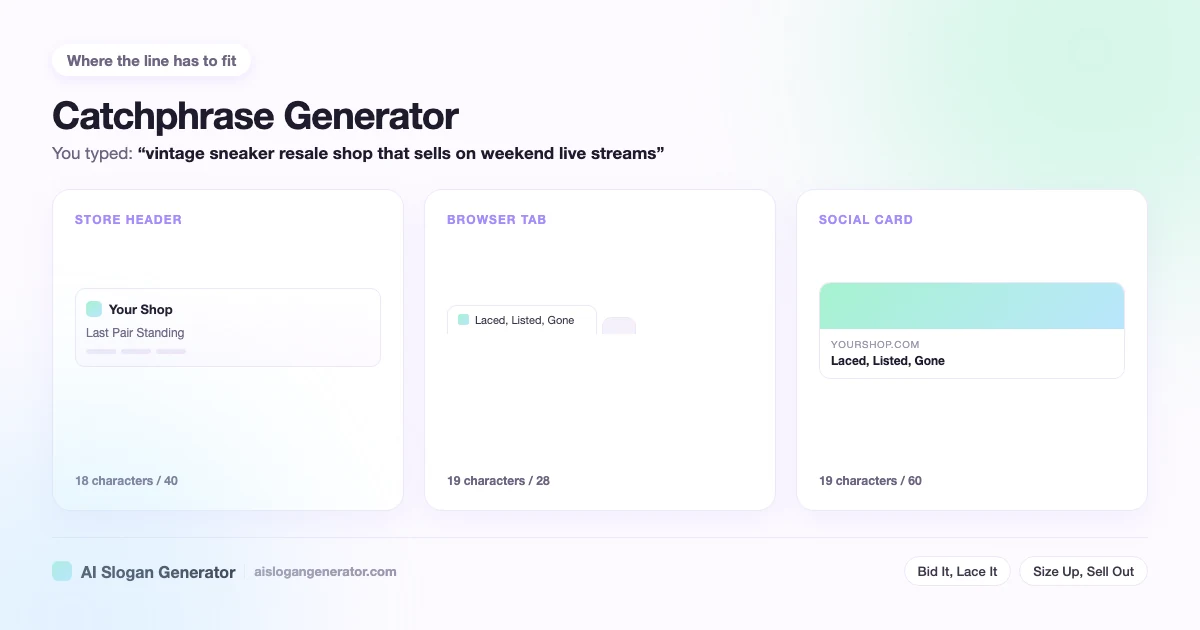
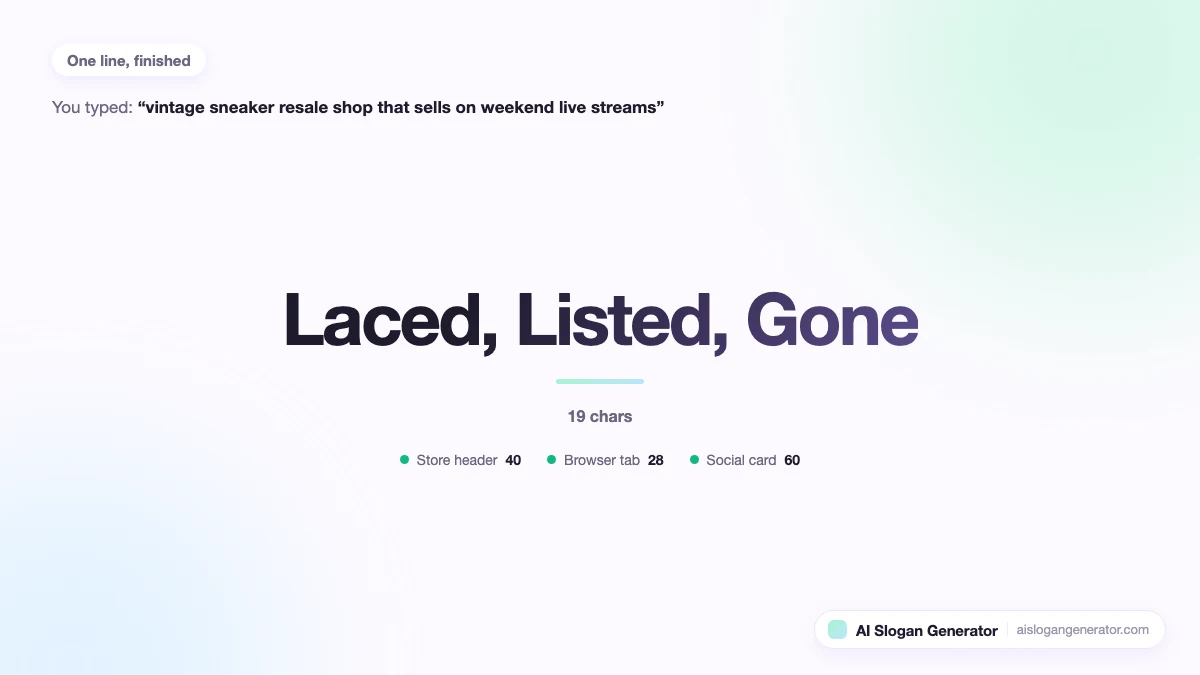
If the line has a comma, count each side separately. Laced, listed, gone is five syllables split into three beats, and each beat can be said alone. That makes it easier to repeat than a single unbroken run of the same length.
Who is supposed to say a catchphrase?
The audience says it, and that is the whole difference between a catchphrase and a slogan, which the brand says about itself. A catchphrase is written for customers, viewers or fans to repeat, so it has to sound like something a normal person would say without feeling like an advert.
This changes how you write it. A slogan can use the word "our". A catchphrase almost never can, because nobody repeats a line that makes them sound like a sales assistant. Write it in the voice of the person repeating it, not the person selling.
It also changes who decides whether you have one. You can choose a slogan. You can only offer a catchphrase and see if people pick it up. The lines this generator returns are candidates for that offer, not finished catchphrases, and the honest way to judge them is to try a few out loud with real customers.
If what you actually need is a line the brand says about itself and keeps for years, the tagline generator is the better starting point. Taglines are built to sit still. Catchphrases are built to move.
What makes a catchphrase stick?
A beat, a twist and a moment. The beat makes it easy to say, the twist gives people a reason to say it, and the moment is the situation where saying it feels natural. A line with all three gets repeated. A line with only one usually gets forgotten.
The twist can be small. A pun, a rhyme, a reversal, or an ordinary phrase used in an odd place. Dill with it is a pun. Crunch first, ask later bends a phrase everyone already knows. One jar never lasts is plain words with a small boast inside.
The moment is the part people forget to plan. A catchphrase needs a place in the routine where it gets said: the start of every live stream, the end of every video, the second a parcel is handed over. Without that moment, even a great line just sits on a page.
The styles below are the ones that tend to work, with the condition each one needs and the way each one fails:
- Pun. Wins when the product has a word people already play with. Fails when the joke needs explaining.
- Three beats. Wins when the line can be chanted or counted out. Fails when one of the three words is weak and the pattern sags.
- Bent idiom. Wins when the original phrase is well known. Fails when the change is so small nobody notices it.
- Call and response. Wins on live streams and at events where a crowd can answer. Fails anywhere people are alone.
- Question. Wins as a sign-off that invites a reply. Fails when the answer is obvious.
How do you run the say-it-twice test?
Say the line twice in a row, at normal speed, then once more in a flat voice. If it still sounds like a line on the third go, it can survive repetition. If it starts to sound like noise or a tongue twister, the people repeating it will stumble too.
The test sounds silly and it is the most useful check on this page. Repetition is the whole life of a catchphrase, so a line that falls apart when repeated has failed at the only job it has. Lines with too many similar consonants usually fail here first.
Three things to listen for on each pass:
- Did you stumble anywhere? That spot will trip other people as well.
- Did any word disappear when you said it fast? People will drop it entirely.
- Did the flat version still sound like a phrase, or just like words? A good catchphrase keeps its shape even when said with no energy at all.
I would run the test on every line in a shortlist before showing it to anyone. In my experience it clears out a good share of the candidates in a minute, and the ones that survive are the only ones worth trying in front of customers.
How do you turn a written slogan into something people will say?
Cut it down to the part with a beat, drop every word that only explains, and rewrite it in the voice of a customer rather than the business. Most written slogans carry one sayable phrase buried inside them. The rewrite is mostly a matter of digging it out.
Take Authentic pre owned sneakers at great prices. Nobody will ever say that out loud. The sayable idea inside it is that pairs sell quickly, and Laced, listed, gone says that in three beats with nothing to explain. The rewrite kept the meaning and threw away the sentence.
The same move works on most lines. Find the verb, find the one concrete detail, and see whether they can stand together in four to six syllables. If the product has a word with a pun waiting inside it, try that next. If the line still needs a full sentence, it is probably a slogan, and the main slogan generator is the better tool for it.
Run this generator with a description that includes the moment the line will be said, such as a sign-off for a weekly video or something buyers shout on a live stream. The lines that come back are shaped by that moment, which is half the work of writing a catchphrase done before you start.